Spam Detector – Free Spam Checker Tool | Toolota
Table of Contents
What This Tool Does
The Spam Detector from Toolota is a powerful, browser-based tool designed to instantly analyze text content for spam indicators. In today’s digital landscape where spam messages flood inboxes, social media, and messaging platforms, having a reliable way to verify content legitimacy is essential. Our Spam Detector provides that verification without compromising your privacy.
Unlike server-based solutions that require sending your data to external servers, our Spam Detector operates entirely within your web browser. This means your sensitive emails, messages, or documents never leave your device, offering unparalleled privacy protection. Whether you’re checking a suspicious email, verifying marketing content, or screening user-generated content, this tool gives you immediate insights into potential spam characteristics.
The Spam Detector is particularly valuable for content creators, marketers, business owners, and everyday internet users who encounter questionable messages regularly. With the rise of sophisticated spam techniques, having a tool that systematically checks for multiple spam indicators can save time, protect against scams, and maintain communication integrity.
How the Spam Detector Works
Our Spam Detector employs a sophisticated multi-layered analysis system that examines content against five primary spam indicators. Understanding these mechanisms helps you interpret results more effectively:
Keyword Analysis
The tool maintains a comprehensive database of spam-associated terms including financial triggers (“cash,” “prize,” “winner”), urgency creators (“urgent,” “act now,” “limited time”), health product references, and common scam terminology. Each occurrence of these keywords contributes to the overall spam score. The system uses word boundary detection to avoid false positives with similar legitimate terms.
Capitalization Pattern Detection
Legitimate writing typically uses capitalization appropriately – primarily for proper nouns and sentence beginnings. Spam often employs excessive ALL CAPS for emphasis and urgency. Our Spam Detector identifies words longer than two characters that appear entirely in uppercase, excluding legitimate acronyms through contextual analysis.
Symbol Frequency Analysis
Repeated exclamation points, currency symbols, or ellipses often characterize spam content trying to create artificial excitement or urgency. The tool scans for patterns like “!!!”, “$$$”, or “…” that appear multiple times within the text, with each instance increasing the spam probability.
URL Detection and Assessment
While legitimate content often includes URLs, spam frequently contains multiple links, particularly to suspicious domains. The Spam Detector counts all HTTP/HTTPS links present in the text. A high URL concentration, especially combined with other spam indicators, significantly raises the spam score.
Repetition Pattern Recognition
Spam content sometimes repeats keywords or phrases excessively to reinforce messaging. The algorithm identifies words (longer than three characters) that appear more than three times in the text, calculating their contribution to the overall spam likelihood.
The system weights these factors differently based on their spam correlation strength, with keywords carrying the highest weight and repetition patterns the lowest. All processing occurs locally via JavaScript, meaning no external API calls or data transfers compromise your privacy.
How This Tool Works: The Most Detailed Section
Using our Spam Detector is straightforward and requires no technical expertise. Here’s the exact process, following the actual interface you’ll encounter:
Step 1: Access the Tool
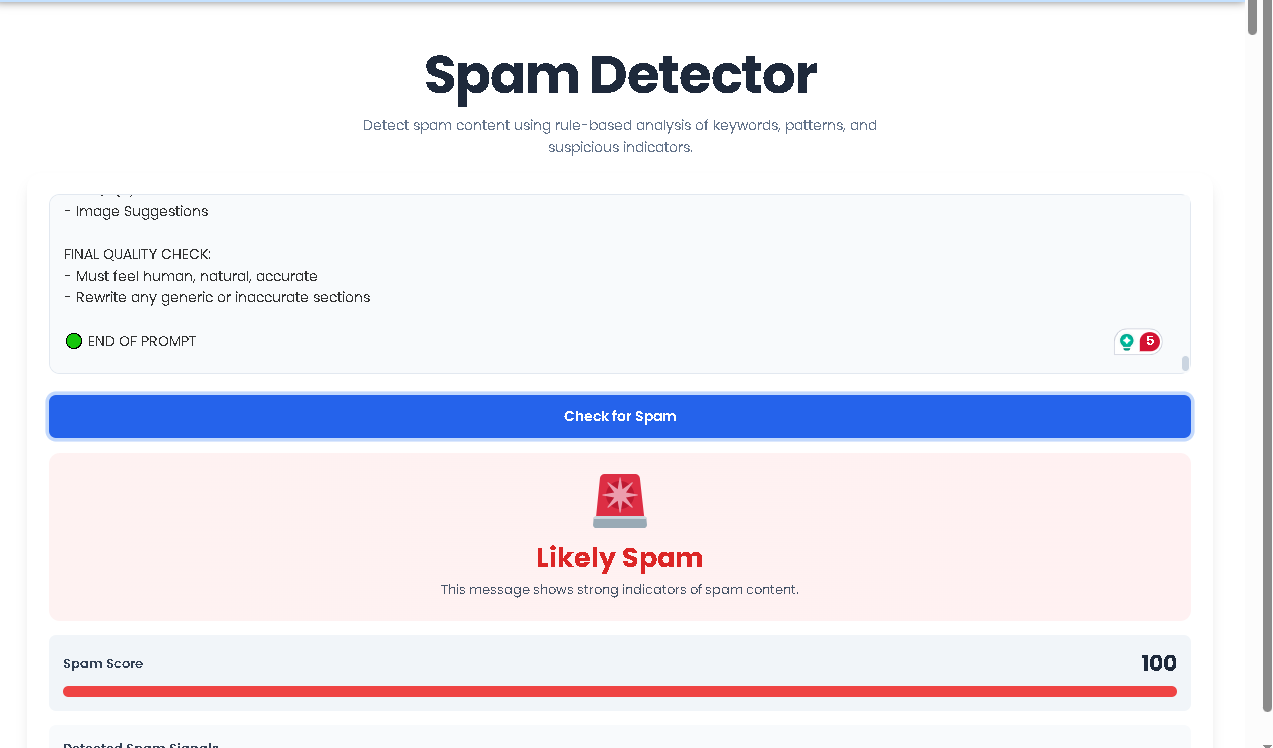
Navigate to the Spam Detector page on Toolota. The interface loads immediately with no registration or login required. You’ll see a clean, intuitive layout with a large text input area prominently displayed.
Step 2: Input Your Text
Click inside the text area labeled “Paste your message or email content here to check for spam…” You can:
The text area supports substantial content – from short messages to lengthy emails. There’s no character limit, though extremely long texts may take slightly longer to process.
Step 3: Initiate Analysis
Once your text is in place, click the blue “Check for Spam” button located directly below the text area. The button features clear visual feedback – it changes color when hovered and shows a focus ring when activated. No additional confirmation is needed; the analysis begins immediately upon clicking.
Step 4: Review Results
After processing (which typically takes less than a second), the results section expands below the button. You’ll see:
The results remain visible until you refresh the page or enter new text, allowing you to study the findings at your pace.
Step 5: Interpret and Act
Based on the results, you can make informed decisions about the content. A “Safe” rating suggests legitimate content, while “Suspicious” or “Likely Spam” ratings indicate potential issues requiring further scrutiny.
Benefits This Tools
Time Efficiency
Manually checking content for spam indicators is tedious and inconsistent. Our Spam Detector automates this process, delivering comprehensive analysis in seconds rather than the minutes or hours manual review would require. This efficiency is particularly valuable for professionals handling large volumes of content.
Enhanced Security
By identifying potential spam before engagement, you reduce exposure to phishing attempts, malware links, and financial scams. The tool serves as an additional security layer, especially useful for less technically-experienced users who might otherwise miss subtle spam indicators.
Content Quality Assurance
For marketers and content creators, the Spam Detector helps ensure communications maintain professional standards. By avoiding spam-associated techniques (like excessive capitalization or urgency language), you preserve brand integrity and audience trust.
Educational Value
The detailed breakdown of detected signals helps users learn what constitutes spam characteristics. Over time, regular use increases personal ability to spot suspicious content without tool assistance, developing valuable digital literacy skills.
Cross-Platform Utility
The browser-based nature means the Spam Detector works identically across operating systems. Whether using Windows, macOS, Linux, Chrome OS, or mobile systems, you receive the same reliable analysis without software installation or compatibility concerns.
Cost Savings
By providing professional-grade spam detection completely free, our tool eliminates the need for paid spam analysis services or software subscriptions. For businesses and individuals alike, this represents direct financial savings while maintaining high-quality analysis.
Understanding Your Spam Detector Results
The Spam Detector presents results through several interconnected components, each providing specific insights:
Status Card Interpretation
The prominent status card uses color psychology and icons for immediate understanding:
Green with ✅: “Safe” rating (score below 25). Content shows minimal spam characteristics. Most legitimate communications fall here.
Orange with ⚠️: “Suspicious” rating (score 25-49). Content contains notable spam indicators warranting closer examination but not definite spam.
Red with 🚨: “Likely Spam” rating (score 50+). Multiple strong spam signals detected. Exercise caution with this content.
Spam Score Analysis
The numerical score (0-100) represents cumulative spam probability based on weighted indicators. The accompanying progress bar provides visual score representation. Scores aren’t absolute but relative indicators – context matters when interpreting.
Signal Details Examination
Each detected signal includes three components:
Signal Type: The category of spam indicator detected
Description: Specific findings (e.g., “Found 4 spam-related keywords”)
Severity Level: Impact assessment (High/Medium/Low)
High-severity signals (🔴) strongly influence scores and typically indicate clear spam patterns. Medium signals (🟠) represent moderate concerns, while low signals (🟡) suggest minor indicators.
Statistical Breakdown Context
The four statistics provide quantitative insights:
Spam Keywords: Count of predefined spam terms found
ALL CAPS Words: Words appearing entirely in uppercase
Excessive Symbols: Instances of repeated punctuation/currency symbols
URLs Found: Web links detected in text
Higher numbers in any category increase overall spam probability, but combinations across categories create the strongest spam indications.
Practical Application of Results
Use results proportionally to their severity. “Safe” ratings generally indicate trustworthy content. “Suspicious” ratings suggest verifying sender authenticity or content purpose before engagement. “Likely Spam” ratings warrant avoidance or deletion, especially with unknown sources.
Important Conditions & Guidelines for Use
Accuracy Limitations
While our Spam Detector employs sophisticated algorithms, no automated system guarantees 100% accuracy. Some legitimate content may trigger false positives (marked as spam when safe), while sophisticated spam may occasionally avoid detection. Use results as informed guidance rather than absolute determination.
Contextual Considerations
The tool analyzes text patterns objectively without understanding context, tone, or intent. Creative writing, marketing copy, or technical content might naturally include elements that appear spam-like. Always apply human judgment considering the source and situation.
Legal and Ethical Use
Employ the Spam Detector for legitimate personal, educational, or business purposes. Do not use the tool to harass individuals, unfairly discredit content, or support illegal activities. Respect copyright by only analyzing content you own or have permission to examine.
No Guarantee of Security
While the tool enhances security awareness, it doesn’t guarantee protection against all digital threats. Continue practicing comprehensive online safety including antivirus software, strong passwords, and cautious link-clicking behavior.
Tool Availability
Toolota provides the Spam Detector free of charge but doesn’t guarantee uninterrupted availability. Maintenance, updates, or technical issues may cause temporary unavailability without notice or liability.
Result Interpretation Responsibility
Users bear ultimate responsibility for decisions based on Spam Detector results. The tool provides information, not recommendations or professional security advice. For critical decisions, consult appropriate cybersecurity professionals.
Frequently Asked Questions (FAQ)