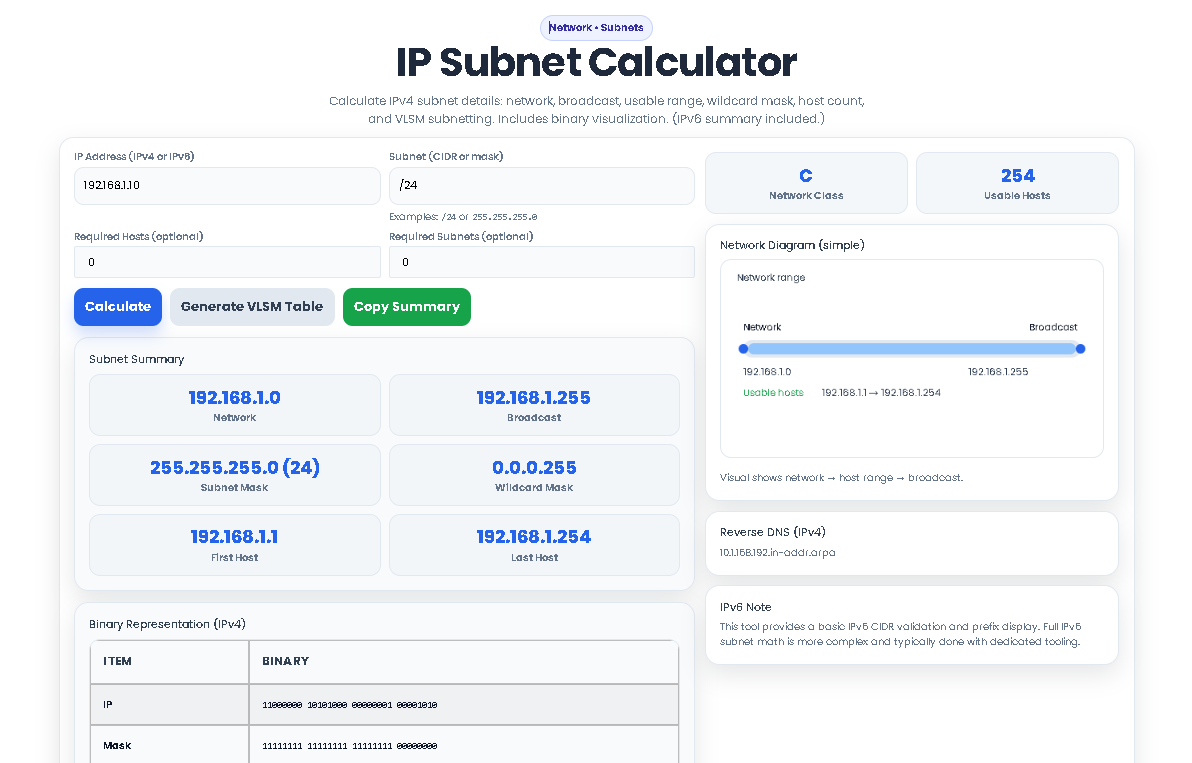
Calculate IPv4 subnet details: network, broadcast, usable range, wildcard mask, host count, and VLSM subnetting. Includes binary visualization. (IPv6 summary included.)
/24 or 255.255.255.0| Item | Binary |
|---|
| # | Network | Usable Range | Broadcast | /CIDR | Hosts |
|---|
Network administration can be complex, but with the right tools, it becomes significantly more manageable. Enter the IP Subnet Calculator from Toolota – a specialized online utility designed to transform the tedious process of manual subnet calculations into a quick, accurate, and effortless task. Whether you’re designing a corporate network, studying for a certification, or troubleshooting connectivity issues, this tool provides instant clarity on your network’s structure.
The modern digital landscape demands precision in network planning. Every device connected to a network requires a unique identifier, and efficient IP address allocation is crucial for optimal performance and security. This is where our powerful IP Subnet Calculator becomes indispensable, converting abstract CIDR notation into actionable network intelligence in seconds.
An IP Subnet Calculator is a digital tool that automates the mathematical process of subnetting – dividing a larger network into smaller, more manageable subnetworks. At its core, it interprets Classless Inter-Domain Routing (CIDR) notation (like /24 or /16) and calculates all relevant network parameters automatically.
When you input an address like 192.168.1.0/24 into Toolota’s IP Subnet Calculator, it performs binary operations behind the scenes to determine:
1. The exact subnet mask (e.g., 255.255.255.0)
2. The network address (the “street name” of your subnet)
3. The broadcast address (where messages go to reach all devices)
4. The range of usable host addresses
5. The total number of available addresses
6. The complementary wildcard mask
7 . Binary representations of both the IP and subnet mask
This automated calculation eliminates human error in binary conversion and ensures network configurations are mathematically correct before implementation.
Our IP Subnet Calculator has been designed with user experience as the priority. Here is the exact, step-by-step process based on the actual HTML interface:
Navigate to Toolota’s dedicated IP Subnet Calculator page. The clean, intuitive interface loads immediately with a prominent input field ready for your data.
In the input field labeled “IP Address with CIDR,” type your network address in the correct format. The format must be: [IP Address]/[CIDR]. For example:
192.168.1.0/24
10.0.0.0/16
172.16.32.0/22
The placeholder text (e.g., 192.168.1.0/24) serves as your formatting guide. The input field features real-time validation styling with a blue focus ring when active.
Press the blue “Calculate” button, or simply hit “Enter” on your keyboard. The IP Subnet Calculator instantly validates your input:
It checks for correct IP octet ranges (0-255)
It verifies CIDR is between 0 and 32
It ensures proper formatting with the slash separator
If any format is incorrect, a clear alert message guides you to correct it.
The IP Subnet Calculator immediately displays organized results in three clear sections:
A. Summary Cards (Top Section)
IP Address: Shows your input with CIDR in a blue-highlighted box
IP Class: Displays the traditional class (A, B, C, D, or E) in green
Subnet Mask: Presents the dotted-decimal subnet mask in purple
Wildcard Mask: Shows the inverse mask used for ACLs in orange
B. Network Information Table
This detailed table provides:
Network Address (the base of your subnet)
Broadcast Address (the top of your subnet)
First Usable Host Address
Last Usable Host Address
Total Hosts (including network and broadcast)
Usable Hosts (available for device assignment)
C. Binary Representation
For those who need deeper technical insight:
Binary IP Address (each octet shown as 8 bits)
Binary Subnet Mask (visualizing the network/host boundary)
Change your input to calculate different scenarios, or use the “Clear” button to reset the IP Subnet Calculator for a fresh calculation.
To fully appreciate what an IP Subnet Calculator does, it helps to understand what it’s calculating.
CIDR Notation (Classless Inter-Domain Routing) represents the subnet mask as a suffix after a forward slash. The number indicates how many bits in the 32-bit IP address are devoted to the network portion. For example:
/24 means 24 network bits, 8 host bits
/16 means 16 network bits, 16 host bits
/28 means 28 network bits, 4 host bits
Subnet Masks are 32-bit numbers that separate the IP address into network and host portions. They’re typically displayed in dotted-decimal notation:
/24 = 255.255.255.0
/16 = 255.255.0.0
/28 = 255.255.255.240
The magic of an IP Subnet Calculator lies in its ability to instantly convert between these representations and calculate all derived values. When you enter 10.10.0.0/22, the calculator determines this means:
Subnet Mask: 255.255.252.0
Network Address: 10.10.0.0
Broadcast Address: 10.10.3.255
Usable Hosts: 10.10.0.1 through 10.10.3.254
Total Addresses: 1,024
Usable Hosts: 1,022
This complex calculation, which would take minutes manually, happens instantly with our IP Subnet Calculator.
Time Efficiency: Manual subnet calculation requires converting to binary, performing bitwise operations, then converting back to decimal. An IP Subnet Calculator accomplishes this in milliseconds, saving network professionals hours weekly.
Accuracy Assurance: Human error in binary math is common, especially with complex subnetting. Our IP Subnet Calculator eliminates calculation mistakes that could lead to network misconfiguration, conflicts, or downtime.
Educational Value: For learners, watching how changing the CIDR affects all parameters provides intuitive understanding that theoretical study alone cannot offer. The binary visualization is particularly instructive.
Network Optimization: By quickly testing different CIDR values, you can find the optimal balance between number of subnets and hosts per subnet for your specific needs, ensuring efficient IP address utilization.
Troubleshooting Speed: When diagnosing network issues, an IP Subnet Calculator quickly confirms whether an IP address falls within the expected range, whether a subnet mask is configured correctly, or if addresses are overlapping.
Documentation Consistency: Network documentation requires precise subnet information. Using the same IP Subnet Calculator ensures all team members reference identical network boundaries in diagrams, configurations, and policies.
Pre-deployment Validation: Before implementing network changes, verifying calculations with an IP Subnet Calculator provides confidence that the new configuration will work as intended without conflicts.
Input Accuracy Matters: The IP Subnet Calculator processes exactly what you provide. Ensure your IP address contains valid octets (0-255) and your CIDR is between 0-32. The tool validates these but cannot interpret typos like 192.168.1.0/33 or 192.168.1.256/24.
Network vs. Host Addresses: Remember that the first address in any subnet is the network address (cannot be assigned to a device), and the last is the broadcast address (also cannot be assigned). Our IP Subnet Calculator clearly distinguishes these from usable hosts.
Real-World Considerations: While the IP Subnet Calculator provides mathematically correct information, real networks may have additional constraints like reserved addresses for gateways, servers, or network devices that further reduce usable addresses.
Private vs. Public Address Ranges: The tool calculates regardless of address class, but remember that private addresses (10.0.0.0/8, 172.16.0.0/12, 192.168.0.0/16) cannot be routed on the public Internet.
Document Your Calculations: When using the IP Subnet Calculator for network planning, save or document the results for future reference, troubleshooting, and team communication.
Complementary Tools: While our IP Subnet Calculator handles the core mathematics, comprehensive network planning may also require tools for supernetting, VLSM (Variable Length Subnet Masking), or address overlap detection.
The IP Subnet Calculator processes all valid CIDR values from /0 to /32 inclusively. For very large subnets (/0 to /7), you’ll see massive host counts (millions to billions). For very small subnets (/31, /32), you’ll see limited or no usable hosts, which is mathematically correct for point-to-point links or single-host allocations.
Currently, Toolota’s IP Subnet Calculator is designed for IPv4 addressing. IPv6 uses a different notation (prefix length with 128-bit addresses) and would require a specialized calculator. The underlying principles of network/host separation remain similar, but the implementation differs significantly.
Our IP Subnet Calculator performs exact 32-bit unsigned integer operations in JavaScript. If you’re seeing differences, check that your manual calculation uses unsigned integers (not signed) and accounts for JavaScript’s bitwise operators treating numbers as 32-bit signed integers. The calculator handles these edge cases correctly.
The web-based IP Subnet Calculator is fully responsive and works perfectly on mobile browsers. While there isn’t a separate native app, you can add it to your home screen for app-like access. The interface automatically adjusts to smaller screens while maintaining all functionality.
Toolota is your all-in-one online tools platform. Fast, simple, and free utilities designed to make everyday digital tasks easier and smarter.
