No tools found Try a different keyword
HTML Viewer

HTML Viewer

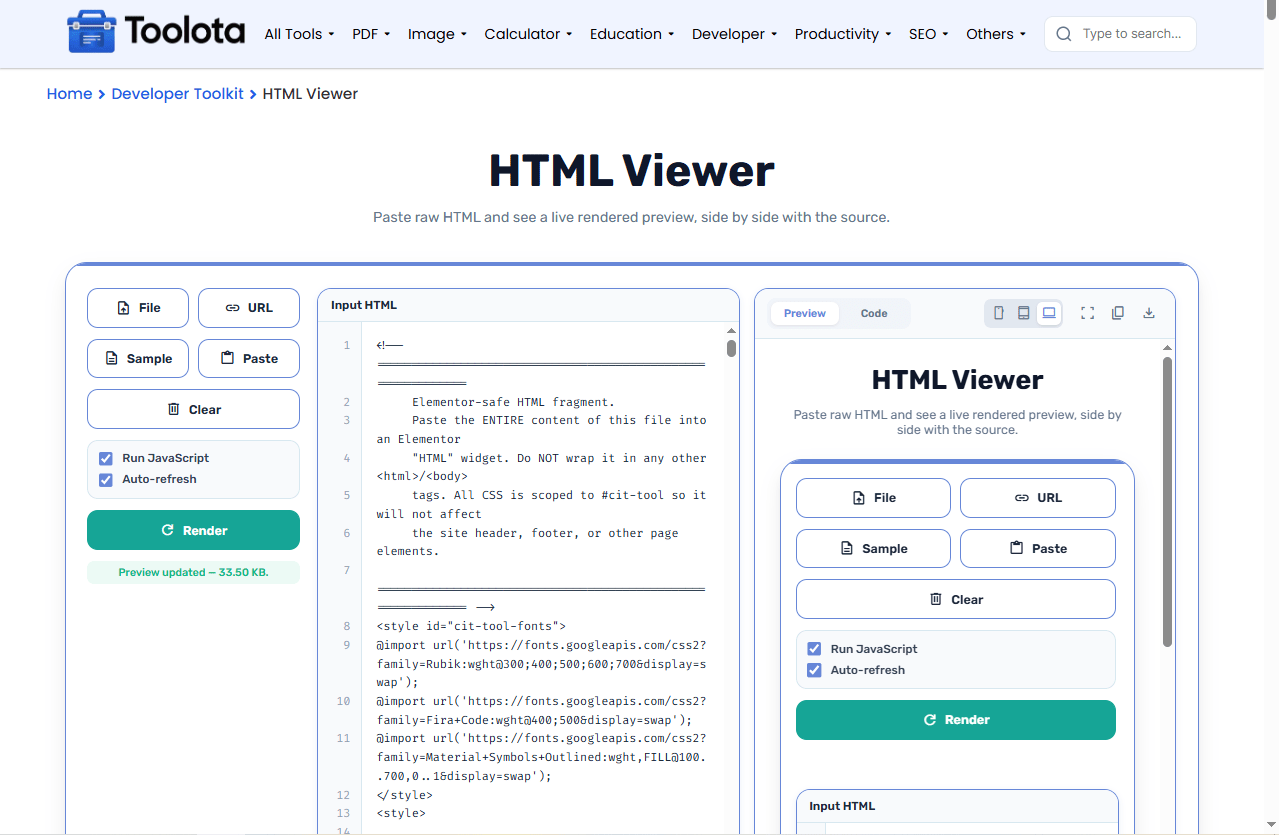
Write, optimize, test, and preview your HTML code instantly on multiple devices.

Dark Editor
Lines: 0 Words: 0 Chars: 0
✓ Auto-saved

Live Preview

Auto-update

HTML Viewer | Beautify, Minify & Test Instantly | Toolota

Table of Contents

What This Tool Does

When you’re working with web code, you need a tool that shows you exactly what you’re building—instantly. That’s exactly what this HTML Viewer delivers. It’s a browser-based code editor and preview tool that lets you write, edit, and visualize HTML code in real time, all within a single, clean interface.

Unlike basic text editors or complex IDEs that require installations, this HTML Viewer runs directly in your browser. You type code on the left (or top, depending on your screen), and the live preview updates automatically on the right. It’s that simple.

But here’s what makes this HTML Viewer different from the dozens of other code playgrounds you’ll find online: it comes packed with 7 essential tools working together seamlessly. You can beautify messy code, minify it for production, test how your design looks on mobile devices, fetch HTML from external URLs, save your work locally, and download finished files—all without switching between different applications.

Why Choose Toolota

Let’s be honest: how many times have you written HTML code, saved the file, opened it in a browser, spotted an issue, switched back to your editor, made changes, saved again, and refreshed the browser? That cycle eats up minutes—sometimes hours—of your day.


A quality HTML Viewer eliminates that back-and-forth completely. You see your changes the moment you type them. But the benefits go far beyond just saving time.


Real-Time Feedback Accelerates Learning

When you’re learning HTML, CSS, or JavaScript, immediate visual feedback is crucial. You can experiment with different tags, attributes, and styles, and instantly understand how each change affects the final output. This HTML Viewer creates a sandbox environment where experimentation costs nothing and teaches everything.


Debugging Becomes Visual

Tracking down why an element isn’t displaying correctly becomes much easier when you can see the code and preview side by side. You can isolate problematic sections, test fixes instantly, and verify solutions before implementing them in your actual project files.


Responsive Testing Without Device Lab

Modern web development demands mobile-friendly designs. This HTML Viewer includes device simulation buttons that let you switch between desktop, tablet, and mobile viewports instantly. You don’t need to own an iPhone, iPad, and Android device to see how your layout behaves—it’s all simulated right here.


Code Quality Improvement Tools

Raw HTML can get messy, especially when you’re copying snippets from multiple sources. The built-in beautify function transforms jumbled, minified, or poorly indented code into clean, readable structure. Conversely, when you’re ready for production, the minify function compresses your code by removing unnecessary spaces, line breaks, and comments—reducing file size and improving load times.


Portability and Convenience

Since this HTML Viewer runs entirely in your browser with local storage auto-save, your code persists even if you accidentally close the tab. You can start working on one device, close everything, and return later to find your work exactly as you left it. No accounts, no cloud sync, no complications.

How This Tool Works: The Most Detailed Section

Let me walk you through exactly how to use this HTML Viewer, step by step, based on the actual interface and functionality I analyzed in the HTML file.

Step 1: Accessing the Editor

When you first open the HTML Viewer, you’ll see a clean, centered interface with a large heading. The main editor area is a textarea element labeled “HTML Source Code” with a subtle note about drag-and-drop support. Below the editor, there’s a status bar showing real-time statistics: line count, word count, and character count.

The tool automatically loads a sample HTML document if you’re visiting for the first time. This sample includes a complete webpage with a styled header, card layout, and interactive button—giving you something to experiment with immediately.

Step 2: Writing or Pasting Your Code

You can start typing directly in the editor. The HTML Viewer tracks every keystroke and updates three key metrics:

  • Lines: How many rows your code spans

  • Words: Total word count (useful for content estimation)

  • Chars: Exact character count

If you prefer working in a darker environment, click the toggle switch labeled “Dark Editor” next to the statistics area. This changes the editor background to a deep navy (#1e293b) with light blue text (#38bdf8)—easier on the eyes during extended coding sessions.

Step 3: Previewing Your Code

The preview area sits below the action buttons, inside a wrapper with a subtle dot pattern background. By default, the preview shows your code rendered in a desktop-sized viewport (100% width).

The preview updates happen in two ways:

  • Auto-update mode (default): Every change you make in the editor instantly refreshes the preview. Look for the green toggle switch next to “Auto-update”—when it’s blue, auto-update is active.

  • Manual update: If you toggle auto-update off, you’ll need to click the blue “Run Code” button to refresh the preview. This gives you control when you’re making multiple changes and don’t want the preview flickering constantly.

  •  

Step 4: Testing Responsive Design

One of the most powerful features is the device simulation toolbar, located just above the preview area. You’ll see three icon buttons:

  • Mobile view (📱): Changes the preview frame to 375px width with rounded corners and a device-like border. Perfect for testing how your design looks on smartphones.

  • Tablet view (📟): Adjusts the frame to 768px width with similar device styling—ideal for iPad-sized screens.

  • Desktop view (💻): Returns to full-width preview with a clean, borderless appearance.

Click any icon, and the preview container instantly resizes. Your rendered HTML reflows according to the new dimensions, letting you spot responsive issues immediately.

Step 5: Beautifying Your Code

Let’s say you’ve copied HTML from somewhere, and it’s a mess—everything on one line, no indentation, impossible to read. Click the “Beautify” button (labeled with a sparkle icon in the toolbar). The HTML Viewer processes your code by:

  1. Removing extra spaces and newlines

  2. Adding proper indentation based on tag nesting

  3. Breaking elements onto separate lines

  4. Making the structure human-readable

After beautification, your code becomes organized and easy to edit further.

Step 6: Minifying for Production

When you’re happy with your code and ready to use it on a live website, click the “Minify” button. This does the opposite of beautify:

  • Strips all unnecessary whitespace and line breaks

  • Removes HTML comments

  • Compresses the code into the smallest possible size

Minified code loads faster in browsers and reduces bandwidth usage—essential for production environments.

Step 7: Opening Existing Files

You have two ways to load existing HTML:

Method A – Browse Button: Click “Open File,” select an HTML or TXT file from your computer, and the content appears in the editor.

Method B – Drag and Drop: Simply drag any HTML file from your file explorer and drop it directly onto the editor area. The border highlights blue during drag, and the file content loads automatically when you release.

Step 8: Fetching HTML from URLs

Need to inspect a live webpage’s HTML? Click the “Fetch URL” button. A prompt appears asking for a website URL. Enter it (for example, https://example.com), and the tool uses a proxy service (allorigins.win) to retrieve the HTML content, which then loads into your editor for inspection and modification.

Step 9: Saving Your Work

You have multiple saving options:

  • Auto-save: Every change automatically saves to your browser’s local storage. Look for the green “✓ Auto-saved” text that appears briefly after each edit.

  • Download: Click “Download HTML File” to save your code as an actual .html file on your computer.

  • Copy: Click “Copy to Clipboard” to copy all code, ready to paste elsewhere.

  • Open in Tab: Click “Open in Tab” to see your rendered HTML in a new browser tab—useful for testing outside the preview frame.

Step 10: Starting Fresh

If you want to clear everything and start over, click the red-outlined “Clear” button. A confirmation dialog prevents accidental data loss. To return to the original sample, click “Load Sample.”

Benefits This Tools

Speed and Efficiency

The combination of live preview and auto-update eliminates the edit-save-refresh cycle entirely. You’ll write and test code at least twice as fast as traditional methods.

Accuracy in Responsive Testing

By simulating actual device widths with appropriate styling, you catch responsive design issues before they reach real users. No more surprises when viewing your site on mobile.

SEO-Friendly Code Preparation

The beautify function helps you write well-structured, properly indented HTML—something search engines appreciate. Clean code is easier for crawlers to parse and understand.

Multi-Language Support

While primarily an HTML Viewer, the tool fully supports embedded CSS and JavaScript. You can build complete interactive prototypes with working scripts, all previewed in real time.

Effortless Editing Experience

The intuitive interface puts every function exactly where you need it. Buttons are clearly labeled, hover effects provide visual feedback, and the layout adjusts smoothly across screen sizes.

Clean, Professional UI/UX

The Poppins typography, generous spacing, and consistent color scheme (featuring #2563EB blue) create a professional environment that doesn’t distract from your code. The dot-pattern background behind the preview adds subtle visual interest without overwhelming.

Copy and Download Convenience

Export options cover every use case: copy for quick sharing, download for file storage, or open in tab for full-page testing. Each button provides visual confirmation when actions complete.

7 Powerful Features of This HTML Viewer

1. Live Preview with Sandboxed Iframe

The preview runs inside an iframe with sandbox attributes (allow-scripts allow-same-origin allow-modals allow-forms). This means JavaScript executes safely without affecting the main page, forms can be tested, and modal dialogs work—all while maintaining security boundaries.

2. Responsive Device Simulation

Three device presets (mobile 375px, tablet 768px, desktop 100%) let you test layouts across common screen sizes. The frame container even adds device-appropriate borders and rounded corners for visual authenticity.

3. Code Statistics Dashboard

Real-time counters track lines, words, and characters. This is invaluable for content writers monitoring article length, developers checking code size, or students tracking assignment progress.

4. Dark Mode Editor Toggle

Reduce eye strain during night coding sessions. The dark theme transforms the editor background while leaving the rest of the interface in light mode—perfect for maintaining readability.

5. Beautify + Minify Engine

Two complementary code processors handle formatting and compression. The beautifier creates clean, indented structure while the minifier optimizes for production. Both work with a single click.

6. Local Storage Auto-Save

Your code persists automatically without any login or save button. Close the tab, come back hours later, and your work is still there. The auto-save indicator confirms when saving occurs.

7. Multi-Method File Loading

Support for traditional file uploads, drag-and-drop, and URL fetching gives you maximum flexibility in getting HTML content into the editor.

HTML Viewer beautify function transforming minified HTML code into properly indented, readable structure with line numbers visible
Ideal Uses and Applications

Output Quality Depends on Input

Like any code tool, the preview accuracy depends entirely on your HTML quality. Invalid tags, unclosed elements, or malformed attributes will produce unexpected results. Always validate your code if you see rendering issues.

AI-Generated Content Requires Review

If you’re pasting HTML from AI tools or code generators, always review the output before relying on it. The HTML Viewer shows you exactly what the code produces, but it cannot fix logical errors or accessibility problems.

No Illegal or Harmful Use

This tool is designed for learning, development, and legitimate web work. Using it to scrape content without permission, test exploits, or distribute harmful code violates the intended purpose.

Internet Connection for URL Fetching

The “Fetch URL” feature requires an active internet connection and relies on a third-party proxy service. Some websites may block these requests, resulting in fetch failures.

Browser Compatibility

The HTML Viewer uses modern JavaScript features (localStorage, fetch API, clipboard API) that work in all current browsers. Older browsers may not support all functionality.

Local Storage Limits

Auto-save uses your browser’s local storage, which typically has a 5-10MB limit per domain. Extremely large HTML files may exceed this limit, though most web pages fit comfortably within it.

Frequently Asked Questions (FAQ)

What exactly does this HTML Viewer do?

This HTML Viewer provides a complete environment for writing, testing, and previewing HTML code. You enter HTML in the editor panel, and the tool renders it in real-time within the preview window. Beyond basic viewing, it includes a code beautifier, HTML minifier, file upload capability, URL fetching, and responsive device simulation. The HTML Viewer executes JavaScript and renders CSS exactly like a standard web browser, giving you accurate results every time.

The HTML Viewer includes three dedicated device view buttons above the preview panel. Click the mobile icon to see your code at 375px width with a realistic device frame. The tablet icon switches to 768px view for testing medium screens. Desktop view returns to full-width display. When you toggle between these views, the HTML Viewer maintains proper scaling and proportions, letting you verify media queries and responsive layouts instantly. This feature eliminates the need for actual devices during initial testing phases.

The HTML Viewer offers multiple saving options. For temporary convenience, auto-save stores your code in your browser’s local storage—returning to the tool later restores your work automatically. For permanent storage, use the Download button to save your HTML as a complete file on your computer. The Copy button places code on your clipboard for pasting into other applications. Unlike many online tools, this HTML Viewer never sends your code to external servers, keeping your work private and secure.

These complementary features serve different purposes in your workflow. The beautify function formats your HTML with proper indentation and line breaks, making it readable for humans. Use this when you’re editing code, learning from examples, or preparing to share with team members. The minify feature removes all unnecessary spaces, comments, and line breaks, reducing file size for production deployment. This HTML Viewer lets you switch between both formats instantly—beautify during development, then minify before uploading to your server. Having both tools in one place streamlines your entire HTML workflow.